

Last Updated: October 26, 2026
Quick Summary
RV rental sites differ most in who owns the vehicle, what the nightly rate includes, and how much of the total cost hides in fees. The average RV rental in the U.S. ran $198 per night as of March 2026, but fees and insurance can increase the trip total beyond the nightly rate; the amount depends on the actual quote and rental terms. Compare total costs, not advertised rates, on the same dates, vehicle class, and pickup city.
- A two-week rental averaged about 14% less per night than a one-week rental for the same vehicle.
- Mileage allowances, one-way fees, cleaning fees, and deductibles can outweigh a cheaper nightly rate.
- Most platforms set a minimum age of 25, with a young-driver surcharge below a higher threshold.
- Price the same trip on at least two platforms and save each quote as a PDF or screenshot.
- RentMyRV.com is developing an owner membership model with zero percentage-based platform booking commission. Membership and other costs still apply; live bookings are not open.
Table of Contents
- What Actually Separates One RV Rental Site From Another
- RV Rental Prices Per Day: What Drives the Number
- RV Rental Fees and Insurance: The Costs Beyond the Nightly Rate
- How to Evaluate RV Rental Sites Before You Book
- What Makes a Better RV Rental Platform for Owners
- Join Early Access and List or Book With Confidence
- Frequently Asked Questions
How to choose an RV rental platform
Start with your role: renters need an available RV and clear trip terms; owners need a suitable advertising channel at a sustainable total cost. There is no single best platform for every traveler or rental business.
- Renters: compare real availability for the same dates and destination, full trip prices, vehicle condition, cancellation rules, and who provides support.
- Owners: compare the membership or commission cost over the same period, realistic booking demand, payment arrangements, listing tools, and your operational responsibilities.
- Considering RentMyRV.com: review the planned owner membership and how it differs as an alternative to RVshare and Outdoorsy. It is still in development; joining early access does not activate a listing or reserve an RV.
For worked examples, use our commission-versus-membership cost guide.
What Actually Separates One RV Rental Site From Another
RV rental sites differ most in three things: who owns the vehicle, what the nightly rate includes, and how much of the total cost hides in fees. According to RV Pro’s coverage of the 2026 RV Rental Price Index, the average RV rental in the U.S. ran $198 per night as of March 2026, up 8.1% year over year. That headline number tells you almost nothing about what you’ll pay.
At RentMyRV, we’re building a marketplace where owners keep 100% of their rental revenue through a flat monthly membership instead of commission.
Inventory, Fees, and Who You’re Really Booking With
An RV rental platform is a marketplace or fleet operator connecting travelers with motorhomes, camper vans, travel trailers, fifth wheels, and toy haulers for short-term use. The two structures behave very differently.
- Peer-to-peer marketplaces: you book from a private owner. Inventory is diverse, from older Class C motorhomes to late-model camper vans.
- Fleet operators: you book from a company with standardized units, centralized roadside assistance, and consistent pickup locations.
A common mistake is comparing a peer-to-peer nightly rate against a fleet rate as if they were the same product. Decide which you want before comparing prices.
RV Rental Prices Per Day: What Drives the Number
RV rental prices per day are driven by vehicle class, season, trip length, and location, not by the platform’s marketing. The $198 national average from the Go RV Rentals 2026 price index is a midpoint across a very wide range.
Length matters more than most renters expect. Based on more than 22,500 sampled quote pairs, Rent-Motorhome.com’s 2026 rental statistics found a two-week rental averaged about 14% less per night than a one-week rental for the same vehicle, city, and travel window.
| Price Driver | Effect on Nightly Rate | What to Do |
|---|---|---|
| Vehicle class | Rates vary by class and listing; a larger RV is not always more expensive | Match class to trip, not to ambition |
| Trip length | Two weeks averaged ~14% less per night than one week | Price a longer window before booking |
| Season | Peak summer demand pushes rates up | Book early or shift to shoulder months |
| Pickup location | Urban and airport locations carry higher rates | Compare nearby pickup points |
| Delivery | Adds a fee but removes tow-vehicle needs | Weigh delivery against fuel and rental car costs |
Build a Side-by-Side Total-Cost Comparison
Most listing pages show a nightly rate and stop. A real comparison puts every line item next to the same line item on a competing quote, using the same dates, vehicle class, and pickup city:
| Cost Line | What to Record | Why It Matters |
|---|---|---|
| Base nightly rate | Rate × nights | The advertised number, not the final one |
| Mileage | Included miles per day, then per-mile overage | A 100-mile daily cap on a 300-mile day adds up fast |
| Insurance / protection | Daily or trip fee, deductible, primary vs. secondary | Deductibles commonly run into the thousands |
| Cleaning fee | Flat fee, and whether tank dumping is extra | Often charged even on short trips |
| Delivery / pickup | Round-trip delivery fee and distance limit | Can replace a rental car or tow vehicle |
| Generator use | Included hours per day, then hourly charge | Matters for off-grid and boondocking trips |
| Service and booking fees | Flat or percentage fees at checkout | Easy to miss until the payment page |
| One-way drop fee | Flat fee plus distance surcharge | Confirm before assuming one-way is available |
| Taxes and surcharges | Local and state charges | Vary by pickup jurisdiction |
Add the lines for two or three platforms and compare totals, not rates. A quote that looks $30 per night cheaper can lose on a $250 one-way fee plus a 100-mile daily cap, and a low protection rate with a high deductible can cost more after one claim than a higher rate with a lower deductible.
Price the same trip on at least two platforms before you book. Save each quote as a PDF or screenshot so you can compare line items side by side after the session expires.
Industry revenue is projected at $931.0 million through the end of 2026, per IBISWorld’s U.S. RV and camper van rental analysis, so supply is not shrinking. Shop more than one platform before you commit.
RV Rental Fees and Insurance: The Costs Beyond the Nightly Rate
RV rental fees and insurance can increase the trip total beyond the nightly rate; the amount depends on the actual quote and rental terms. The base rate is what platforms advertise; the fees are where budgets break.
Mileage, Cleaning, and One-Way Charges to Check Before Booking
Ask about each of these before you enter payment details:
- Mileage allowances: some rates include unlimited mileage; others cap you at a daily allowance and charge per mile beyond it. On a long road trip, this line can exceed the rental fee.
- One-way fees: a one-way rental is convenient and almost always costs extra. Confirm the drop-off fee and whether it varies by distance.
- Cleaning and dumping: many owners charge a cleaning fee, and some charge extra if the holding tanks aren’t emptied.
How to Evaluate RV Rental Sites Before You Book
Evaluating RV rental sites comes down to more than price: confirm eligibility, match the vehicle to your trip, then compare total cost, mileage terms, cancellation policy, protection coverage, and support reachability on the road.
Rental Requirements and Eligibility
Eligibility rules vary by platform and owner, so confirm each of these before you enter payment details:
- Age limits: most platforms set a minimum age, commonly 25, with a young-driver surcharge below a higher threshold. A few allow renters as young as 21 with added fees.
- License: a valid driver’s license is required, sometimes held for a minimum period. International visitors may need an International Driving Permit in addition to their home license.
- Deposits: a refundable security deposit is common, often scaling with vehicle class and deductible. Confirm how and when it is released.
Ask about the deposit hold and the cancellation window in the same conversation. A low nightly rate paired with a large non-refundable deposit is a worse deal than a higher rate with a small refundable hold.
Best Rental Option by Traveler and Trip Type
Inventory lists don’t tell you which unit fits your trip. Use this as a starting point, then confirm tank sizes, sleeping capacity, and towing requirements on the listing:
| Traveler / Trip | Best Fit | Why |
|---|---|---|
| Couples, short weekends | Camper van or small Class B | Easy to drive, lower fuel use, simple setup |
| Families with kids | Class C motorhome | Bunk layouts, more sleeping capacity, onboard bathroom |
| First-time renters | Class C from a fleet operator | Standardized units, centralized support, predictable handover |
| Long-distance trips | Class A or larger Class C | More living space and storage for multi-week travel |
| Off-grid and boondocking | Unit with solar and large holding tanks | Generator hours and tank capacity limit remote stays |
| Towing a boat or toys | Toy hauler or truck camper | Purpose-built cargo space and hitch capacity |
The Five Checks Before You Book
- Price the same trip on two or three platforms. Same dates, same vehicle class, same pickup city, using the total-cost worksheet above.
- Read the fee schedule line by line. Mileage, cleaning, one-way, booking, and second-driver fees.
- Confirm the cancellation window in writing. Screenshot it.
- Ask what protection coverage includes and what the deductible is.
- Check support hours and roadside assistance terms. A 24/7 number that routes to voicemail is not 24/7 support.
A Handover Checklist for Pickup Day
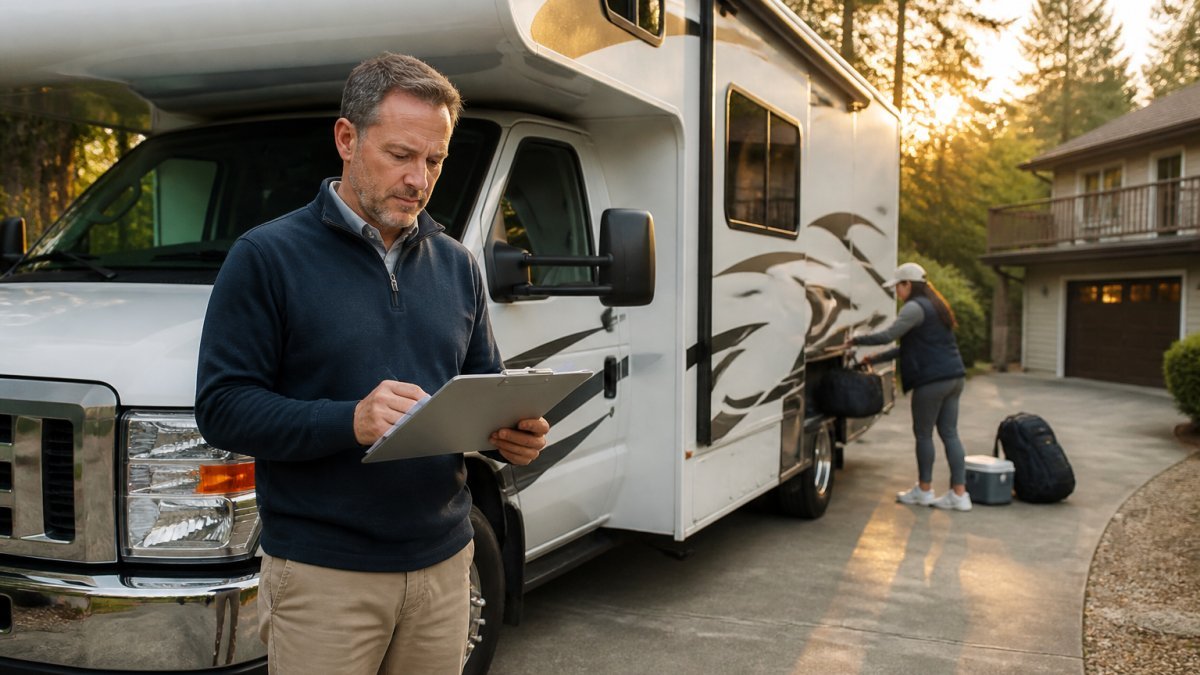
A pickup inspection protects both sides. Walk the unit with the owner and document everything before you drive away.
- Photograph all four sides, the roof line, and the windshield
- Record the odometer and fuel level
- Test every appliance: fridge, stove, water pump, furnace, AC
For a fuller list, our first-time RV rental checklist covers RV types, campsite fit, total costs, and insurance questions to settle before you book.
What Makes a Better RV Rental Platform for Owners
The best RV rental platform for an owner depends on total costs, relevant rental demand, listing tools, support, and the responsibilities the owner retains. A percentage-based commission varies with its stated charge base; a flat membership remains payable for its billing period even when bookings are low. Compare the full terms and realistic rental activity before choosing.
RentMyRV.com is developing an owner membership model with zero percentage-based platform booking commission. Membership fees, optional advertising, payment processing, and operating expenses remain separate; rental revenue is not profit. Owner dashboards and self-service fleet tools are in development. The current informational website collects early-access interest and does not accept live rental bookings or payments.
If you’re weighing models, our breakdown of RV rental commission versus flat membership puts example commissions next to the standard membership and founding rate per paid month in prepaid packages. Owners ready to move can explore founding owner packages at the monthly equivalent, prepaid, with 0% platform booking commission.
Join Early Access and List or Book With Confidence
The RV rental market is valued at $2.88 billion in 2026 and forecast to reach $3.82 billion by 2031, according to Mordor Intelligence’s recreational vehicle rental market analysis. A national market forecast does not establish demand for a particular RV, destination, or new marketplace. Owners should evaluate local inquiries and realistic booking activity.
Travelers can join renter early access for launch updates, trip inspiration, and marketplace news. Questions about how early access works or what renters, owners, and service businesses can expect are covered on our questions and answers page.
Frequently Asked Questions
What is the average cost per day to rent an RV?
The national average nightly RV rental price was $198 as of March 2026, according to the Go RV Rentals 2026 RV Rental Price Index reported by RV Pro, an 8.1% increase year over year. That figure is a national average, so your actual rate depends on vehicle class, location, season, and trip length. Longer bookings often cost less per night: a two-week rental averaged about 14% less per night than a one-week rental across more than 22,500 sampled quote pairs, per Rent-Motorhome.com.
What should I compare when choosing an RV rental site?
Look past the headline nightly rate. Compare the total cost, including booking fees, mileage allowances, insurance or protection coverage, cleaning charges, and one-way fees if you are not returning to the same spot. Check how many vehicles are actually available in your dates and location, whether delivery is offered, and how the platform handles cancellations and roadside assistance. A site with a slightly higher rate but generous mileage and free cancellation can cost less overall.
How do RV rental platforms charge owners?
Most RV rental marketplaces take a commission from each booking, which typically comes out of the owner’s rental revenue. RentMyRV.com is developing a different model: an owner membership with zero percentage-based platform booking commission. Membership and other applicable costs remain separate, and live bookings are not open. When comparing platforms, calculate what you would pay in commission over a season versus a flat membership fee, and check for listing, checkout, or payment processing charges that may not be obvious upfront.
Can you rent an RV directly from its owner?
Yes. Peer-to-peer marketplaces connect travelers directly with private RV owners rather than a rental fleet company. Booking with an owner often means more vehicle variety, from camper vans and travel trailers to toy haulers and Class C motorhomes, and more flexibility on pickup and delivery. Before you book, confirm insurance coverage, ask for a walkthrough of the vehicle’s systems, and photograph its condition at handover so both sides have a record.
Comparing RV rental sites is really a test of patience: the platform that wins is usually the one whose fee schedule you can actually read. RentMyRV is building toward that standard, with a flat monthly membership for owners, a nationwide service directory for the RV community, and early access for travelers who want first look at the marketplace. Get started with RentMyRV and see what a commission-free rental marketplace looks like from the inside.
